
Published in Children’s Voice, Volume 35, Number 1
by Grace Jones, Stephanie Pegues, Allison Lowry, Kyle Hogan, Jennifer O’Brien, Debangshu Roygardner, Kya Barounis, and Jessy Pucker
The child welfare system historically has made decisions on behalf of families and youth without consistently prioritizing their voices. Despite progress over time, the system often remains transactional. It’s characterized by power imbalances and institutional biases that foment distrust among families and youth (Casey Family Programs, 2024).
Child welfare requires a transformative shift in order to place families at the center of decision-making, recognize them as experts on their own lives, and engage them employing curiosity and respect. Through stronger partnerships with families and community providers, agencies can improve outcomes for children and families.
Recognizing the need for systemic change, the Department of Family Services (DFS) in Fairfax County, Virginia, began its journey toward transformation in 2015 by forming a workgroup to select a practice model aligned with its vision and values. After benchmarking 16 jurisdictions and visiting five, DFS selected Safe & Connected™ in 2016. Created by Dr. Suzanne Lohrbach of the KVC Institute for Health Systems Innovation, Safe & Connected™ was the only evidence-informed model found that met the department’s goals of: (a) improving outcomes for children and families; (b) strengthening clinical practice for staff; (c) increasing timeliness, and (d) promoting greater clarity and consistency across programs.
Overview of the Safe & Connected™ Practice Model
Safe & Connected™ disrupts the traditional individualistic model by emphasizing teamwork, critical thinking, partnership with families, and collaboration with service providers to ensure child safety, prevent trauma, and grow resilience. At a foundational level, the model was co-created with community input, guided by social justice principles, and rooted in six Basic Tenets.
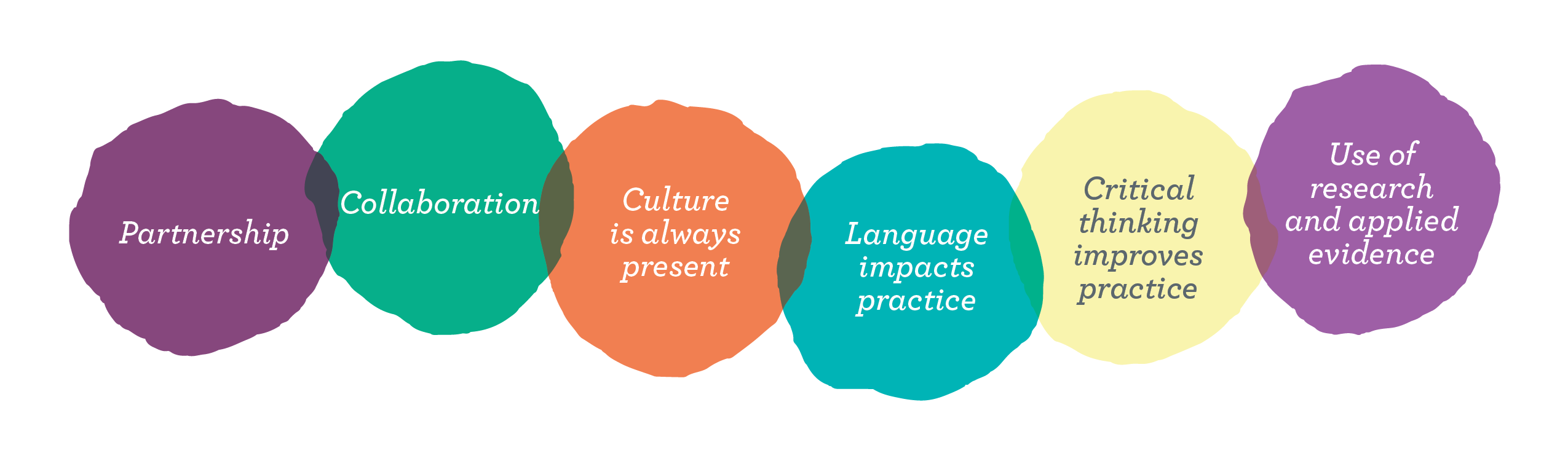
Safe & Connected™ promotes inclusiveness, addresses social injustices, slows the transactional nature of child welfare, and advocates for balanced assessments of strengths, needs, and risks for informed, collaborative decision-making. At its center is the Consultation and Information Sharing Framework®, a structured process designed to organize, assess, and analyze all available family information.
This Framework® keeps families and their well-being at the forefront by encouraging meaningful dialogue, mutual engagement and collaborative decision-making. Decisions become visible, strengths-based, needs-focused, and evidence- informed. The Framework® is innovative in its use of genograms, a visual representation of family structures. This invites professionals to “talk about the family as if they are in the room,” centering each family’s background, culture, and network of support. Safe & Connected™ transforms siloed, transactional processes into sustained, relationship-centered practices, with the ultimate goal of child and family well-being.
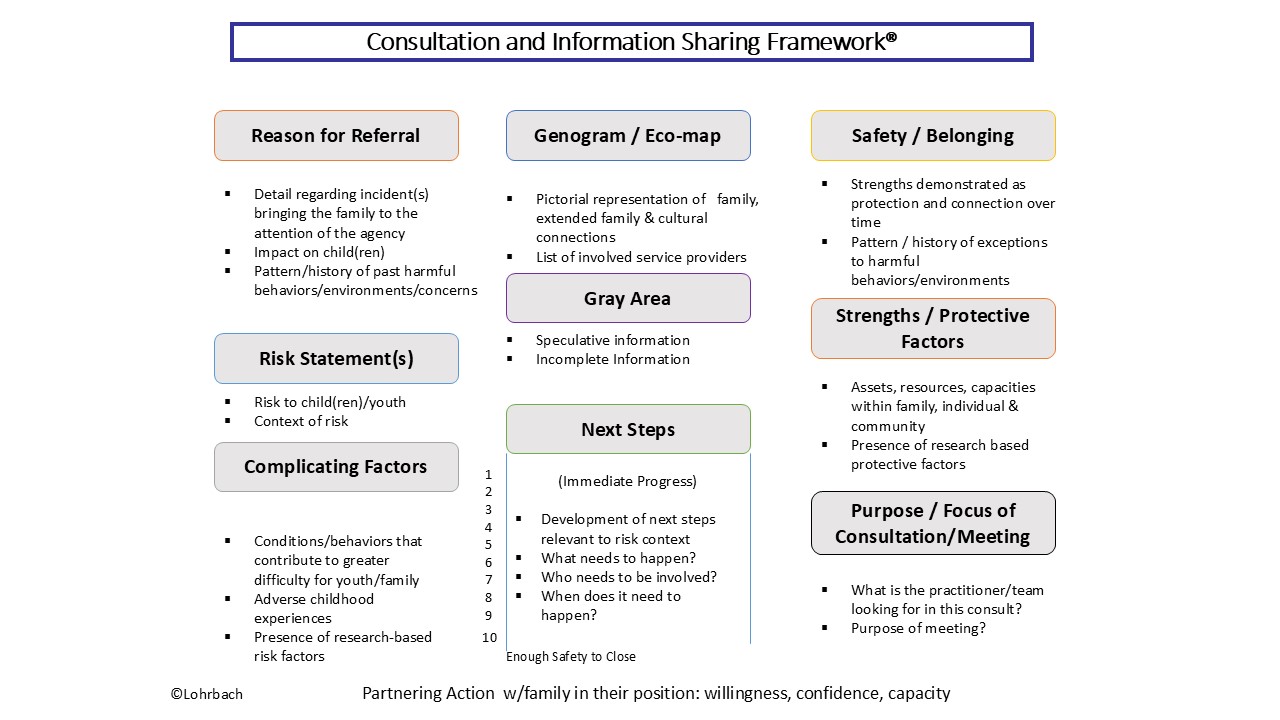
The Framework® empowers youth who are currently in foster care or transitioning out of care to have a voice in decisions shaping their lives. By leveraging cultural networks and community resources, the model minimizes system involvement, builds upon protective factors, and maintains children’s connections to their families and communities. It also enhances the expertise of the child welfare workforce, helping child welfare organizations drive continuous improvement and better outcomes for children, families, and professionals.
Fairfax County’s Implementation Journey
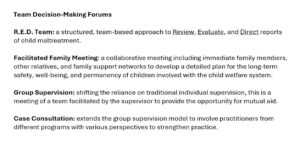
In 2016, the DFS Children, Youth, and Families Division (CYF) began shifting internal infrastructures to support the implementation of Safe & Connected™. CYF introduced the Consultation and Information Sharing Framework® and embedded team-based decision making into key forums such as R.E.D. Team, facilitated family meetings, group supervision, and case consultation. These steps institutionalized critical thinking, enhanced collaboration, and supported adoption of the model’s Basic Tenets. Over the past eight years, CYF has integrated the model into agency communications, professional development, and new strategic priorities, ensuring its sustainability.
CYF’s journey toward transformation faced significant challenges, including leadership changes, staff turnover, high workloads, and reduced workforce capacity that slowed the adoption of new practices. Implementing Safe & Connected™ without a manual made a difficult transition more complex. Resistance resulted from these pressures and staff perception that it would be excessively time-consuming to adapt. This led some practitioners to revert to transactional, incident-based approaches.
To address these barriers, CYF established a project implementation team with representatives from all child welfare areas to develop a strategic plan for sustainable change. CYF successfully developed new team decision making structures, encouraged meaningful family involvement, and supported continuous practice improvement. Safe & Connected™ helped institutionalize critical thinking and translated research into day-to-day practice.
Evaluating the Process and Outcomes
In 2022, KVC Institute for Health Systems Innovation partnered with Chapin Hall, a nonprofit policy and research center, to develop a manual and fidelity measures to monitor adherence to Safe & Connected™. In 2024, they sought to launch a formal evaluation to understand the impact of the model on children and family outcomes. Chapin Hall is leading that evaluation of Safe & Connected™ in Fairfax County.
This evaluation is focused on several components:
Process evaluation:
- Examining challenges and facilitators of successful implementation.
- Tracking fidelity metrics to determine consistent service delivery of the model.
- Assessing the model’s impact on workforce job satisfaction and burnout.
Outcomes evaluation:
- Examining metrics including family stability, prevention services, new maltreatment allegations, and out-of-home placements compared to other Virginia jurisdictions.
Chapin Hall will use rigorous research methods meeting the criteria for potential review by the Title IV-E Prevention Services Clearinghouse established by the Administration for Children and Families (ACF) within the U.S. Department of Health and Human Services (DHHS). By taking part in this evaluation, Fairfax County DFS will help contribute to broader research on effective child welfare practices and systemic transformation.
Impacts on Practice
Fairfax is focusing on several areas that contribute to system change. In 2016, Fairfax County adopted the “One Fairfax” racial and social equity policy. This foundation helps CYF’s work to continue to adapt and evolve with the changing social and political landscape and community needs in alignment with the Basic Tenets of Safe & Connected™.
Further internal collaboration with KVC Institute for Health Systems Innovation resulted in the creation of the Safe & Connected™ Practice Guidance Profiles, outlining what optimal practice in child welfare looks like. The profiles integrate the CYF mission, vision, and values with the Virginia Department of Social Services (VDSS) Practice Profiles. CYF has prioritized family-centered decision making in its expansion of kinship care initiatives and facilitated family meetings.
CYF’s Child Welfare Institute has integrated Safe & Connected ™ into the curriculum and a Practice Improvement Team exists to support optimal practice. CYF has introduced Safe & Connected™ to VDSS, judges, attorneys, educators and other community partners with the future goal of shared decision making and ownership with community members, families, and youth. Collaboration is happening in facilitated family meetings and other decision-making spaces. The blueprint exists within our system and can continue to be expanded.
A Commitment to Building a Family-centered System
Transforming child welfare systems requires moving from transactional, compliance-driven approaches to person-centered frameworks that recognize families as experts in their own lives. Fairfax County’s implementation of Safe & Connected™ exemplifies this shift, prioritizing transparency, collaboration, and respect to engender more equitable and effective service delivery. Fairfax County remains committed to elevating daily practice, professional development, and strategic planning through the model.
The future requires continued innovation, evaluation, and partnership. Fairfax County has demonstrated that placing families at the center using a lens of respect, equity, and shared purpose is a necessary and achievable pathway to systemic change. Together, child welfare agencies, community providers, and families can build a system that uplifts and empowers every child and family it seeks to serve.
Grace Jones is the Assistant Program Manager in Child Protective Services and Protection and Preservation Services within the Children, Youth, and Families Division of Fairfax County’s Department of Family Services. In her role, she supports efforts to assess abuse and neglect while delivering services to families through a lens of equity and compassion. Drawing on her own lived experience in the child welfare system, she combines personal insight with professional expertise. Jones holds a Master of Public Administration from The Pennsylvania State University and a Bachelor of Social Work from Millersville University. She is devoted to meaningful collaboration that strengthens family connections and drives systemic change rooted in equity, safety, and resilience.
Stephanie Pegues is the Family Engagement Program Manager in the Children, Youth, and Families Division of Fairfax County Department of Family Services. Her work focuses on implementation of Safe & Connected ™, professional development, facilitated family meetings, and equity work. She holds a Master of Social Work from Howard University and has 34 years of experience in human services. Pegues is excited about collaboration, elevating practice, engaging families and their supports, and pushing for system transformation which leads to better outcomes and equity for youth and families.
Allison Lowry serves as the Assistant Division Director for Programs and Services in the Children, Youth, and Families Division of Fairfax County’s Department of Family Services. In this leadership capacity, she focuses on project management, program and policy development, and strategic initiatives, all aimed at safeguarding children and fostering resilience in families. With over two decades of experience, Lowry collaborates across programs, divisions, and community partners to design and implement innovative practices. She holds a Master of Public Administration from the George Washington University. As an advocate for child welfare, Allison is committed to advancing initiatives and practice that improve outcomes for children and families who are vulnerable.
Kyle Hogan most recently served as the Child Welfare Practice Improvement Supervisor with the Children, Youth, and Families Division of the Fairfax County Department of Family Services. He holds a master’s degree in Clinical Mental Health Counseling from The College of New Jersey and is passionate about advancing trauma-informed, equity-driven child welfare practice.
Jennifer O’Brien is a Senior Policy Fellow at Chapin Hall and specializes in providing implementation and capacity building assistance to public and private child welfare agencies nationwide. O’Brien has extensive experience supporting Family First implementation and in designing practice models and strategic plans for both states and private agencies. O’Brien has a Master of Science in Counseling and Bachelor of Science in Psychology from Western Illinois University.
Dr. Debangshu Roygardner is a Senior Researcher at Chapin Hall, where his work focuses on implementation science, continuous quality improvement, and program evaluation. He has 12 years of experience in research administration including serving as Lead Evaluator on a 5-year, $2 million dollar SAMHSA grant as well as leading data analysis for 0-5 programming in Washington D.C. He also has eight years of experience in psychotherapy and mental health administration including the implementation of evidenced based trauma models in New York City. Roygardner obtained his PhD in Psychology with a Developmental concentration and an Africana Studies Certificate at the Graduate Center at the City University of New York. He obtained his Master’s in Mental Health Counseling at New York University and his BS in Human and Organizational Development at Vanderbilt University, where he was a Posse Scholar.
Dr. Kya Barounis is a Senior Researcher at Chapin Hall. Her work focuses on using research evidence and administrative data analysis to improve the performance of child welfare and child mental health systems. Prior to joining Chapin Hall, Barounis was a Senior Researcher at the Child and Adolescent Services Research Center (CASRC). Her career has focused on improving outcomes for youth involved in public human service systems through various projects. She holds a PhD and a Master of Social Work from the University of California, Berkeley, and a Bachelor of Science from Northwestern University.
Jessy Pucker is an Associate Policy Analyst at Chapin Hall. Pucker focuses on supporting the implementation of Motivational Interviewing under the Family First Prevention Services Act. Her other projects include supporting jurisdictions in implementation and CQI, evidence-based practice evaluation, and policy research. Pucker brings prior experience in social work, family services, and mental health treatment. Her past professional experiences with direct service help provide a foundation for her systems-level work. She holds a Bachelor of Arts from Northwestern University and a Master of Social Work from Columbia University.
References
Casey Family Programs. (2024). Transforming child welfare systems [Issue brief]. https://www.casey.org/shared-power-rise/
Lohrbach, S. (1999). Consultation & information sharing framework.
Lohrbach, S. (2024). Safe & Connected™ Practice Model Manual 2024. KVC Institute for Health Systems Innovation. https://www.kvc.org/the-safe-connected-model/